
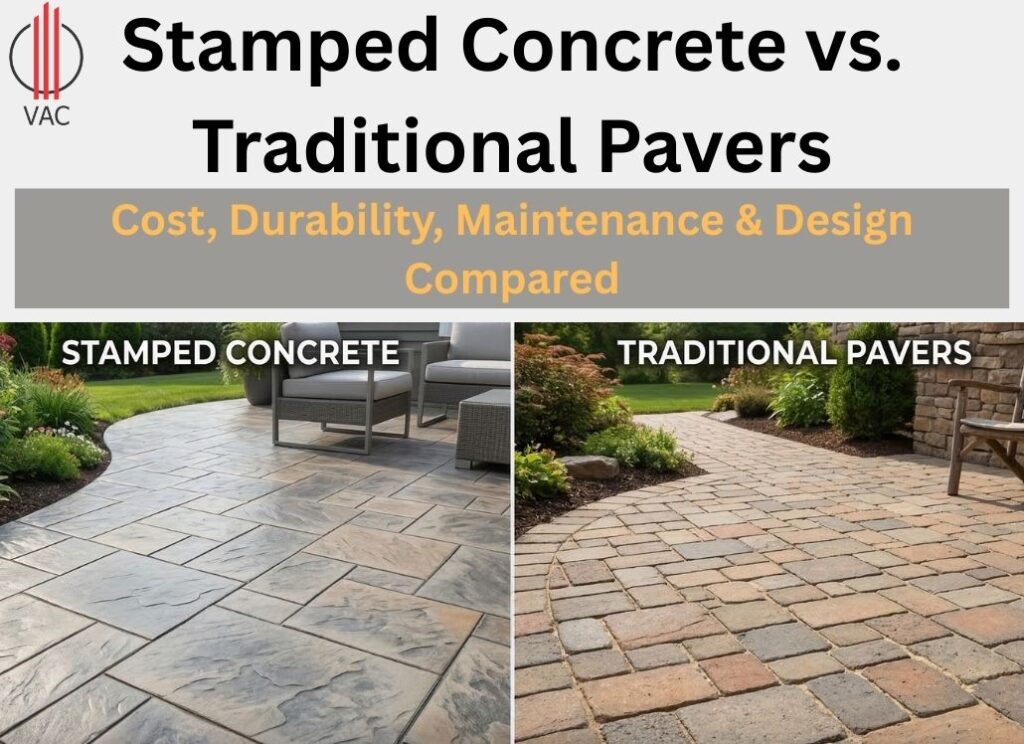
When choosing outdoor flooring for driveways, patios, walkways, pool decks, or commercial landscapes, stamped concrete and traditional pavers are two of the most commonly compared options. While both enhance aesthetics and functionality, they differ significantly in cost, durability, maintenance, installation method, and long-term performance.
This guide provides a clear, side-by-side comparison of stamped concrete vs pavers, helping you select the most suitable material based on usage, climate conditions, budget, and design goals.
What Is Stamped Concrete?
Stamped concrete is a decorative concrete flooring system where freshly poured concrete is textured and colored to replicate materials such as natural stone, slate, brick, cobblestone, or wood planks. The result is a seamless, monolithic surface that combines structural strength with architectural appeal.
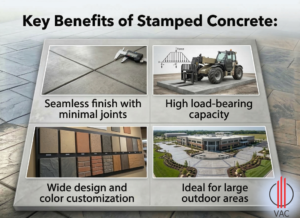
Key Benefits of Stamped Concrete
- Seamless finish with minimal joints
- High load-bearing capacity
- Wide design and color customization
- Ideal for large outdoor areas
Common applications:
Stamped concrete driveways, patios, walkways, pool decks, courtyards, plazas, and commercial outdoor spaces.
What Are Traditional Pavers?
Traditional pavers are individual modular units made from concrete, clay brick, or natural stone. These units are installed over a compacted base and joined using sand or polymeric compounds.
Key Characteristics of Pavers
- Segment-based installation
- Easy unit replacement
- Natural material appearance
- Flexible layout patterns
Common applications:
Garden pathways, sidewalks, landscape areas, and low-traffic outdoor zones.
Stamped Concrete vs Pavers – Installation Comparison
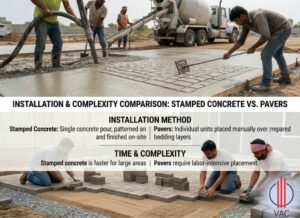
Installation Method
- Stamped Concrete: Single concrete pour, patterned and finished on-site
- Pavers: Individual units placed manually over prepared bedding layers
Time & Complexity
- Stamped concrete is faster for large areas
- Pavers require labor-intensive placement
Faster installation reduces labor costs for stamped concrete in large-scale projects.
Design & Aesthetic Flexibility
Stamped Concrete Design Advantages
- Mimics premium materials at lower cost
- Continuous patterns without visible joints
- Custom borders, textures, and color blends
Paver Design Limitations
- Visible joints interrupt seamless aesthetics
- Limited pattern continuity in large spaces
Durability & Structural Performance
Stamped Concrete Durability
- Reinforced concrete slab
- Handles heavy vehicular and foot traffic
- Long lifespan (20–30 years with sealing)
Paver Durability
- Dependent on base preparation
- Risk of settlement and movement over time
Stamped concrete is better suited for driveways and commercial outdoor flooring.
Maintenance Requirements
| Feature | Stamped Concrete | Traditional Pavers |
| Weed Growth | Minimal | Common |
| Cleaning | Easy | Moderate |
| Repairs | Occasional | Frequent |
| Resealing | 2–3 years | Joint maintenance often |
Cost Comparison – Short & Long Term
Initial Cost
- Stamped concrete is more cost-effective for large areas
- Pavers involve higher material and labor costs
Long-Term Cost
Stamped concrete generally results in lower lifetime ownership costs due to:
- Fewer repairs
- Minimal joint maintenance
- Reduced weed control
Performance in Indian Climate Conditions
In hot, humid, and monsoon-prone climates:
- Stamped concrete performs better with proper sealing
- Pavers may experience joint erosion and weed growth
This makes stamped concrete a climate-resilient outdoor flooring solution.
Sustainability & Material Efficiency
Stamped concrete:
- Uses fewer raw materials
- Generates less construction waste
- Requires fewer transportation cycles
This supports sustainable hardscape design.
Repair & Replacement Considerations
- Pavers allow easy unit replacement
- Stamped concrete requires skilled repair but fails less frequently
When Should You Choose Stamped Concrete?
Stamped concrete is ideal if you need:
- Seamless premium aesthetics
- Low-maintenance outdoor flooring
- Cost efficiency for large spaces
- High durability for driveways and plazas
Professionally engineered stamped concrete systems—such as those provided by VAC for residential and commercial outdoor applications—are designed to balance design consistency, durability, and long-term performance, making them suitable for Indian site conditions.
When Are Pavers More Suitable?
Choose pavers when:
- Underground access is frequently required
- Small decorative landscaping areas are involved
- Natural stone authenticity is essential
Final Comparison Summary
Both stamped concrete and traditional pavers offer value, but they serve different priorities. For projects that demand seamless aesthetics, structural strength, climate resistance, and minimal maintenance, stamped concrete often delivers superior long-term performance.
FAQ Section
Is stamped concrete cheaper than pavers?
Yes, stamped concrete is usually more cost-effective for large outdoor areas due to lower labor and maintenance costs.
Does stamped concrete crack easily?
When installed correctly with joints and reinforcement, stamped concrete performs reliably and resists structural cracking.
Which is better for driveways—pavers or stamped concrete?
Stamped concrete is generally better for driveways due to its monolithic strength and load-bearing capacity.